vitamin d in healthy adults Globally
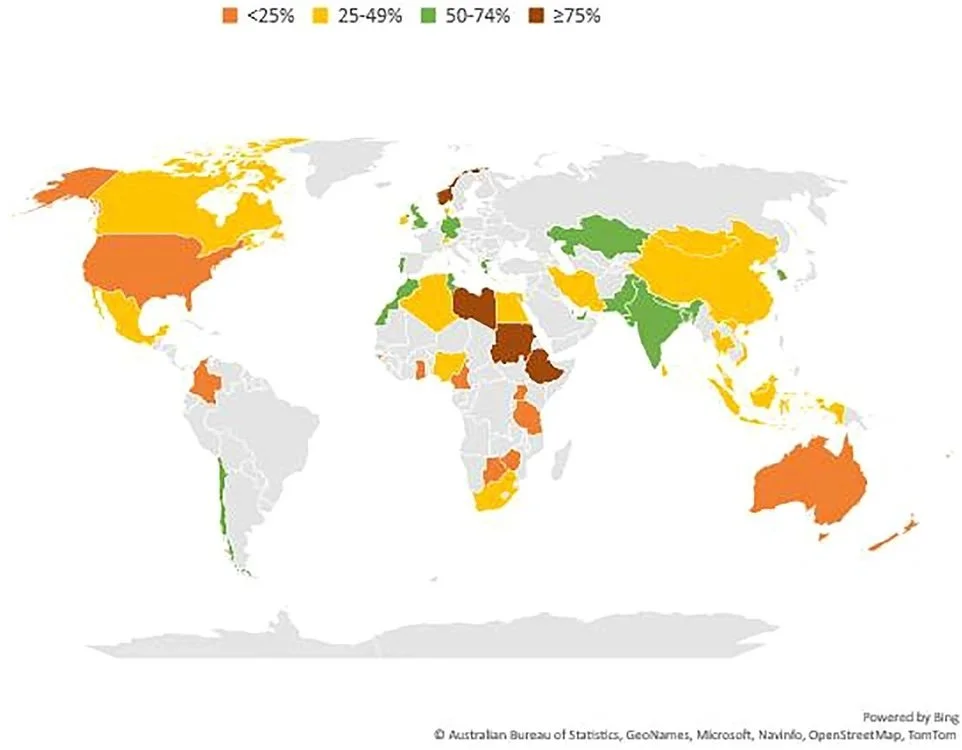
Prevalence of vitamin D deficiency (25(OH)D < 50 nmol/L) doi: 10.1007/s43630-023-00375-8 Creative Commons licence
Vitamin D deficiency is common worldwide.
Back in 2018, no model would predict clinical vitamin D pharmacokinetics.
Following vitamin D oral administration, attained serum concentrations of its metabolite 25-hydroxyvitamin D (25(OH)D) are variable among people. Given vitamin D has been known for a long time, this situation is really odd!
We developed the first-ever predictive model [1] that could accurately predict the mean serum 25(OH)D concentrations in healthy adults. The model was fitted to 56 clinical trial arms, and was validated by another 99 arms. The model made accurate predictions for doses from 10 µg (400 IU) to 20,000 µg (2 million IU), irrespective of the race, geographic location and the season.
We discovered the baseline vitamin D synthesis rate could explain most variability in the mean PK for each arm. In this model, all other parameters were the same for all arms [1].
Simulate the model here
1. Huang, Z., & You, T. (2021). Personalise vitamin D3 using physiologically based pharmacokinetic modelling. CPT-Pharmacometrics & Systems Pharmacology, 10(7), 723-734. doi:10.1002/psp4.12640
pharmacokinetics in diverse populations
✔ Are PBPK models sloppy?
✔ How can you predict with confidence?
✔ Which open project is worth doing?
UK adults
The UK Scientific Advisory Committee on Nutrition recommends a reference nutrient intake of 10 μg/day (400 IU/day) vitamin D in winter and spring for the general population and 10 μg/day all year round for the at-risk groups. However, the US National Academy of Medicine recommends a daily allowance of 15 μg/day (600 IU/day) vitamin D for 1–70-year-olds, and 20 μg/day (800 IU/day) for those older than 70 years. What are the implications for the UK population?
To inspect the difference, we first refined our model using nonlinear mixed effects [2]. We discovered weight could improve the predictions. We simulated the British adults and found
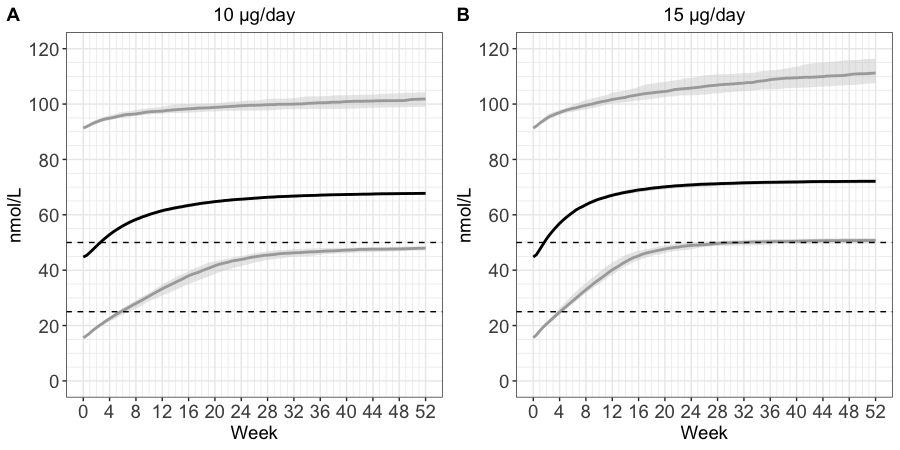
The 10 μg/day dose is predicted to get 95.0% British adults to reach the 50 nmol/L target within 32 weeks
The 15 μg/day dose is predicted to get 97.5% British adults to reach the 50 nmol/L target within 28 weeks
The difference is 2.5% of British adults, just over 1.3 million in the 2021 Census
For the lower UK DHSC target of 25 nmol/L, 97.5% of vitamin D deficient cases would reach the target within 4 weeks with the 15 μg/day dose, and 6 weeks with the 10 μg/day dose
Simulation of serum 25(OH)D in British adults
Continuous vitamin D daily dosing at 10 and 15 μg for 52 weeks. Source: Figure 5 from [2].
2. You, T., Muhamad, N., Jenner, J., & Huang, Z. (2024). The pharmacokinetic differences between 10- and 15-μg daily vitamin D doses.. British Journal of Clinical Pharmacology. doi:10.1111/bcp.16146
children in cape town and ulaanbaatar (PHASE III)
In the ViDiKids Cape Town trial, schoolchildren between 6–11 years at baseline received orally administered vitamin D3 once weekly. Serum 25(OH)D was monitored at baseline, 6, 12, 24 and 36 months. We customised the PBPK model, and fitted it to 77 children [3]. The model made accurate predictions for another 463 Cape Town children from the same trial. Using the Cape Town model, we found the average increase in serum 25(OH)D is lower among the Mongolian children from Ulaanbaatar than Cape Town children.Collaborators: Adrian Martineau (QMUL), Keren Middelkoop (Cape Town) and Davaasambuu Ganmaa (Harvard)
Honorary Research Fellow: Nadda Muhamad (Kasetsart)
3. Muhamad, N., Walker, N., Middelkoop, K., Ganmaa, D., Martineau, A. R., & You, T. (2025). Physiologically Based Pharmacokinetic Modelling of Serum 25-Hydroxyvitamin D Concentrations in Schoolchildren Receiving Weekly Oral Vitamin D3 Supplementation. NUTRIENTS, 17(19): 3028. doi:10.3390/nu17193028


under 18’s in europe and the US
The US National Academies of Sciences, Engineering, and Medicine (NASEM) suggest serum 25-hydroxyvitamin D (25(OH)D) >125 nmol/L is linked to potential toxicity. The European Food Safety Authority (EFSA) recommends that daily doses up to 2000 IU (50 µg) are safe for children aged 1–10 years, and 4000 IU (100 µg) for those aged 11 years and over. With PBPK modelling, we demonstrated these two recommendations are inconsistent: At the EFSA safe doses, many under 18's are expected to achieve 25(OH)D > 125 nmol/L [4]. We scrutinised the currently adopted 125 nmol/L threshold. The supporting evidence appears heterogeneous and limited. It may warrant re-evaluation, Further pharmacokinetic modelling work is needed to support the development of vitamin D safety parameters and guidelines. Honorary Research Fellow: Nadda Muhamad (Kasetsart)
4. Huang, Z., Muhamad, N., Christie, S., You, T. (2026) Pharmacokinetics Modelling Reveals Inconsistency Between the US and European Vitamin D Safety Guidelines. Biomedicines. 14(9), 1974; doi:10.3390/biomedicines14091974